Osborne bull
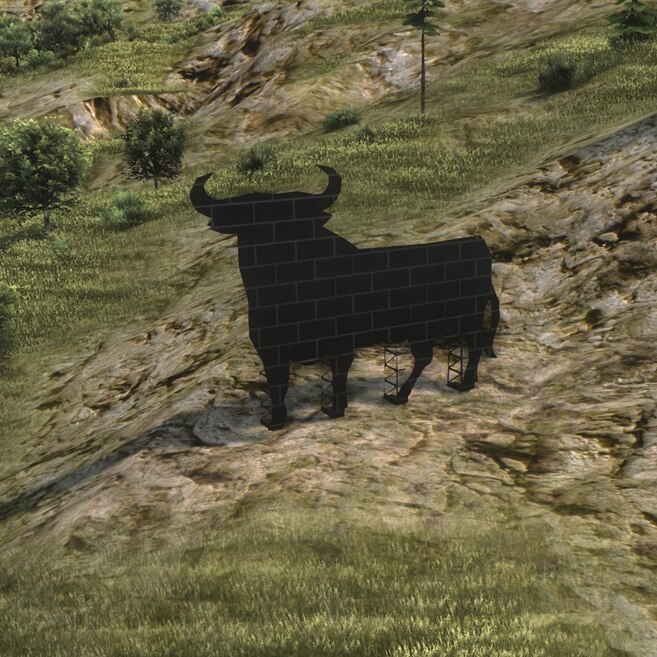
Created in 1956 by graphic designer Manolo Prieto for the beverage company Grupo Osborne to promote Jerez Veterano brandy, The Osborne Bull is an iconic billboard that consists of the stylized silhouette of a fighting bull. The billboards are distributed across throughout the entire Spanish geography, generally located next to roads and on hills, so that they integrate into the horizon and facilitate their visibility. Although its original function was advertising, with the passage of time and its cultural roots, the Osborne bull has transcended the limits of the commercial brand, becoming a cultural symbol of Spain.
The first bull was installed in May 1957, at kilometer 55 of the Madrid-Burgos highway, in Cabanillas de la Sierra. It was made of wood and was 7 meters high. In its golden age, in the seventies, there were more than 500 specimens, currently there are 92 bulls distributed irregularly throughout Spain. Similar bulls with the Magno brandy, also placed by the Osborne Group, exist on Mexican roads, there is also another bull in Matsunoyama, Japan.
In July 1988, the General Highway Law required the removal of advertising from any place visible from any state highway, which required the removal of signage. In September 1994, the General Highway Regulations ordered the removal of all bulls and several autonomous communities. Numerous municipalities, cultural associations, artists, politicians and journalists spoke out in favor of maintaining the fences. In December 1997, the Supreme Court ruled in favor of maintaining the Osborne bulls due to the aesthetic and cultural interest attributed to them.
Loyalty strengt 0.3%
Loyalty radius 75m
Pedestrian access 2
GROUNDWORKS
Gravel 0.2
Asphalt 0.1
Concrete 0.2
Workers 8
STEEL LAYING
Steel 0.3
Workers 12
Creada en 1956 por el diseñador grafico Manolo Prieto para la empresa de bebidas Grupo Osborne para promocionar el brandy de Jerez Veterano, El toro de Osborne es un iconico cartel que consiste en la silueta estilizada de un toro de lidia, Las vallas se encuentran repartidas a lo largo de toda la geografia española, generalmente ubicadas junto a carreteras y en cerros, de manera que se integren en el horizonte y faciliten su visibilidad. Aunque su funcion original era publicitaria, con el paso del tiempo y su arraigo cultural, el toro de Osborne ha trascendido los limites de la marca comercial, convirtiendose en un simbolo cultural de España.
El primer toro fue instalada en mayo de 1957, en el kilometro 55 de la carretera Madrid-Burgos, en Cabanillas de la Sierra. era de madera y tenia 7 metros de altura, En su epoca dorada, en los setenta, se llegaron a superar los 500 ejemplares, en la actualidad existen 92 toros distribuidos de forma irregular por toda España. Toros similares con el nombre del brandy Magno, tambien colocados por el Grupo Osborne, existen en las carreteras mexicanas, tambien existe otro toro en Matsunoyama, Japon.
En julio de 1988 la Ley General de Carreteras obliga a retirar la publicidad de cualquier lugar visible desde cualquier carretera estatal, lo que obliga a retirar la rotulacion, en septiembre de 1994 el Reglamento General de Carreteras ordena retirar todos los toros y varias comunidades autonomas, numerosos municipios, asociaciones culturales, artistas, politicos y periodistas se pronuncian a favor del mantenimiento de las vallas, en 1997 en diciembre el Tribunal Supremo dicta sentencia a favor del mantenimiento de los toros de Osborne debido al interes estetico y cultural que se les ha atribuido.
Lealtad generada 0.3%
Radio de lealtad 75m
Accesos peatonales 2
PREPARATIVOS
Grava 0.2
Asfalto 0.1
Hormigon 0.2
Dias de trabajo 8
TENDIDO DE ACERO
Acero 0.3
Dias de trabajo 12

