Wright Flyer I

1903 Wright Flyer I
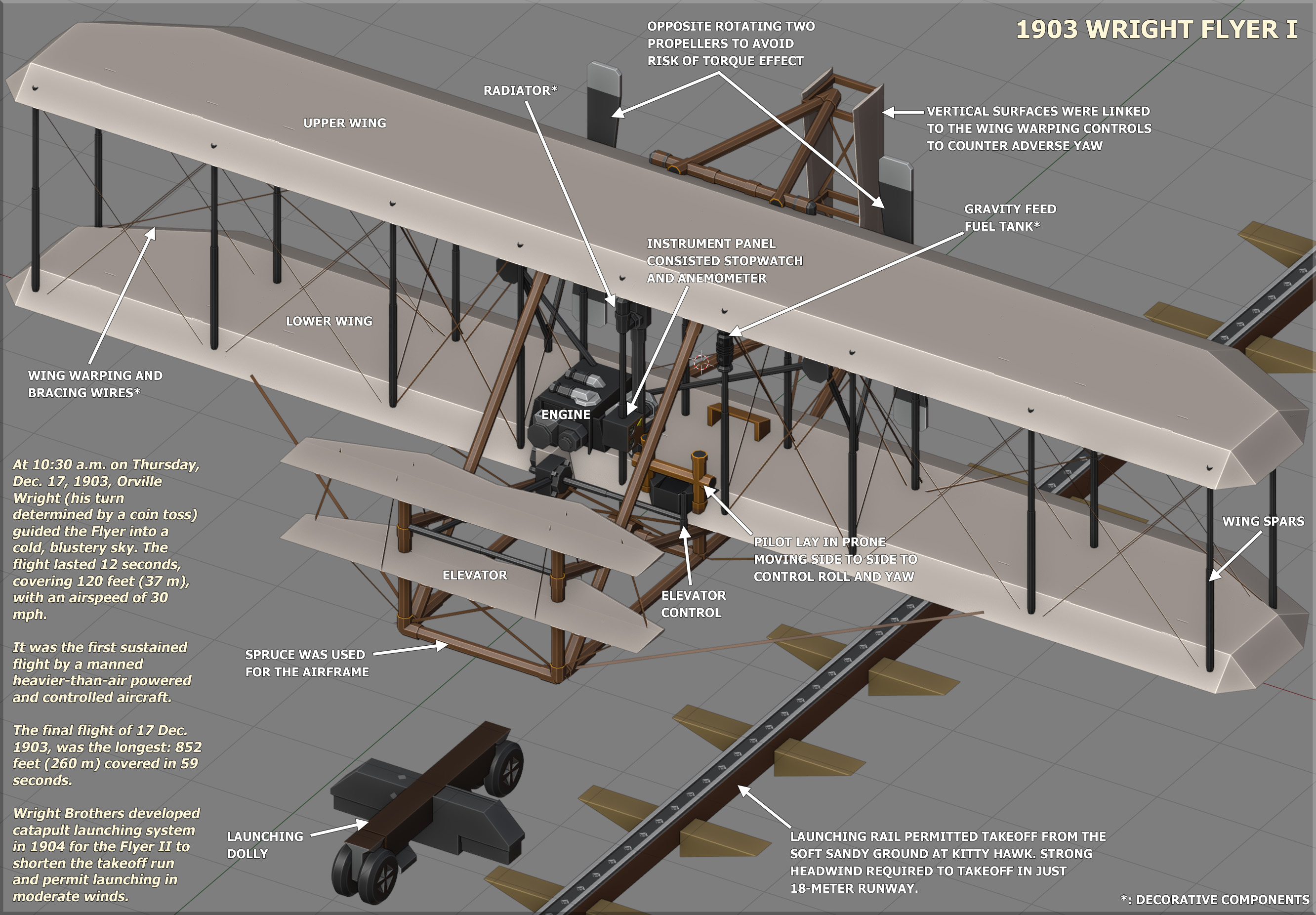
Wright Flyer made the first sustained flight by a manned heavier-than-air powered and controlled aircraft on December 17, 1903.
Approximately it took 50 hours for building and testing and rebuilding and re-testing… However I found interesting to read and watch about its history. Scale is realistic but weight is not. It is heavy because I added every detail I can using XML tricks. It also flies faster than the real Wright Flyer to get enough lift.
1. Go to Settings > Controls, select Vehicle Camera Mode as Free.
2. Unlock the Rail and push it out of the hangar, then lock it. (Don’t unlock the Dolly.) Alternatively you can spawn it via addon editor.
3. In Custom menu, override weather and wind direction. Set wind to 50% and wind direction to have headwind.
4. Get in the Flyer
5. Magneto ON (Hold for a second, because it is a key button)
6. Hand Prop the Airplane (Hold for few seconds)
7. Wait 10-15 seconds for the engine RPM to max out
8. Release to takeoff
9. After gaining some altitude, you can decrease the wind to fly your desired direction easier. It has enough fuel for about 6 km of flight range.
10. There is no throttle. To land, simply fly close to ground and turn off the Magneto.
Wright Flyer I took off with 32 km/h headwind and flew in ground effect. Its top speed was 48 km/h in the air. Wilbur simply run at 16 km/h next to Orville who was flying.
Flyer I was not powerful enough to leave ground effect to gain altitude. High air density, thanks to cold weather in December, was probably also helpful.
High school dropout Wright Brothers’ mechanical background and sharp intelligence produced several breakthroughs on aviation. They made tests in their wind tunnel. They knew that the propeller need to be thin, twisted and rotate at high speed in contrast to ship propellers. They found the best airfoil to get higher lift at low speed. They understand the weight-shifting is not reliable for controlled flight which was the cause of Lilienthal’s crash and death. So they invented wing warping for roll control. They faced adverse yaw problem and solved it by adding rudder control linked to wing warping control.
Wright Brothers kept their work away from public for a long time that caused debate over who was the first to fly. The famous photo of the first flight in 1903 was published four and a half year later in 1908. It was a race and they did not want to share their inventions with the competitors.
Brothers patented for controlling the aircraft by using control surfaces instead of previously known method of weight-shifting. So called "Patent War" was waged to secure monopoly on U.S. aircraft manufacturing. Glenn Curtiss, another American aviation pioneer, derisively suggested that if someone jumped in the air and waved his arms, the Wrights would sue.
Some historians believe the patent war stalled development of the U.S. aviation industry. Perhaps as a consequence, airplane development in the United States fell behind Europe that in World War I.
The Smithsonian Institution refused to accept Wright Brothers as the first to fly. Instead, they honored the Langley’s Aerodrome and put it on exhibition as the first airplane. In 1914, Glenn Curtiss who was in a patent infringement legal battle with the Wrights, restored the Langley’s Aerodrome and flew it to prove it is capable of flight. However modifications Curtiss made on Aerodrome with the knowledge in 1914 were significant. So, later in 1942, Smithsonian Institution acknowledged the Wright Flyer as the first airplane and in 1948 Flyer I returned to U.S. 45 years after its flight in 1903.
Crew : 1 (3 kg) Fuel capacity : 12.5 L (1.25 kg) Gross weight : 1040 kg Dimensions (LWH): 6.4 m – 12.25 m – 2.75 m Wing area : 434 rsa Wing loading : 2.40 kg/rsa Propellers : Two 2-bladed fixed-pitch Powerplant : One 2-cylinder naturally aspirated, producing 500 kg of thrust @ 1350 RPM
Maximum speed : 69 MPH Range : 4 Miles or 6 km Thrust-to-weight: 0.48 rsa: Total rudder_surface_area of horizontal lifting surfaces

