MN De Grasse (1938)
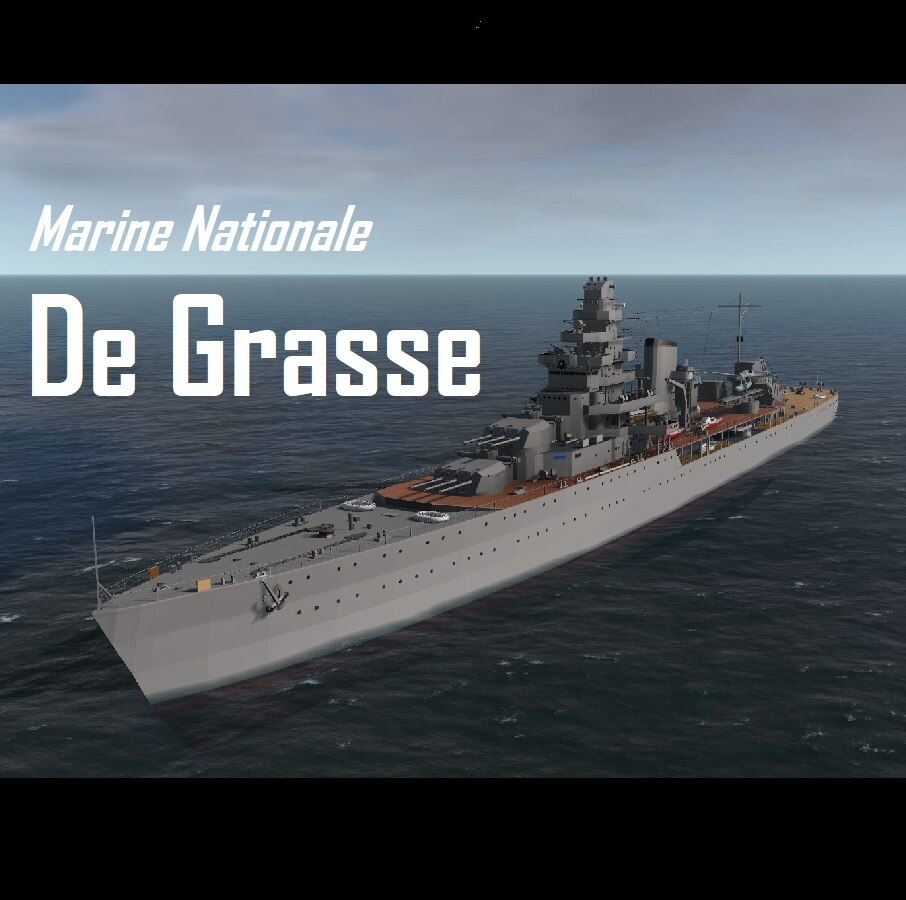
Alarmed by the growing naval capabilities of Nazi Germany and Fascist Italy by 1936, the French Navy began plans for more light cruisers to follow up on the latest six ships of the La Galissonnière class. Although the La Galissonnière were fairly modern designs, France still suffered a shortage of competitive light cruisers, as its fleet still contained several light cruisers designed in the 1920s that had become obsolete. Thus, a class of three ships were authorised; lead-ship De Grasse, Guichen and Chateaurenault.
Compared to the preceding class, the De Grasse would’ve had increase speed, slightly better armor protection, more torpedo tubes, and fully turreted 100mm secondary guns as opposed to the older ships’ partially shielded 90mm guns. The main armament of 152mm guns used the same type of turrets as the Richelieu class battleships’ secondaries; they were technically capable to anti-aircraft fire, although in practice their AA effectiveness was poor. The superstructure, with a large boxy forward bridge, was inspired by that of the heavy cruiser Algerie. Two seaplane catapults were included, but the aircraft hangar was omitted from the final design, possibly because these ships were intended to sail in the relatively calm waters of the Mediterranean.
Of the three ships ordered, only the lead ship was ever built. De Grasse was 28% complete when it was captured by the invading Germans in 1940. After the War, the ship was entirely rebuilt during the 1950s to become an anti-aircraft, and later a research ship to support France’s nuclear testing projects. De Grasse was decommission in 1972, and scrapped in 1974, having never carried her original weapons loadout.
No mods needed!
Length: 191 m/ 626 ft
Beam: 21.4 m/ 70 ft
Speed: 34.5 knots from 110,000 horsepower driving 2 shafts
Weapons
3 x triple 152mm main gun
3x twin 100mm dual-purpose secondary gun
4x twin 37mm AA gun
8x 20mm AA
2x triple torpedo launcher
Armor
100mm belt and bulkheads
50mm deck

