Longer Wars / Slower Battles
CORE CHANGES:
– Longer Wars and Slower Battles (about 3x)
– Adjustments to White Peace values
– Minor and Insignificant Country Buffs
-> Insignificant nations have 80% reduction in war support loss due to casualties, while minor nations have 40% reduction. Additionally, there are buffs for army/navy defense (40% / 20%) and reductions in the number of provinces lost/occupied (50% / 25%).
COMPATIBILITY: This mod is lightweight, making only a few adjustments to defines and introducing modifiers to minor and insignificant country ranks. It has been designed with compatibility in mind and should work seamlessly with almost any mod, including total conversions.
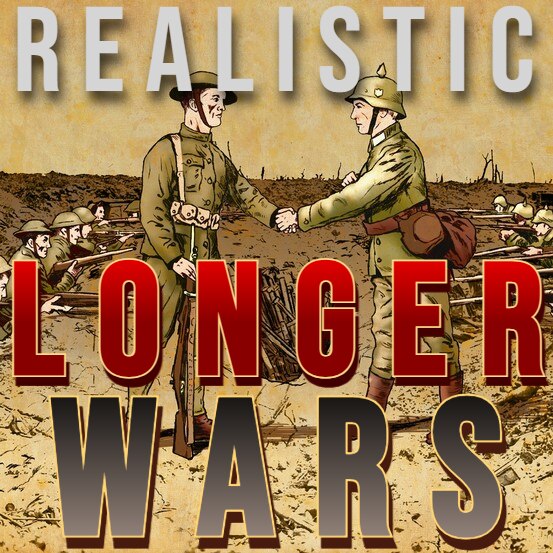
This mod aims to significantly slow down battles, increasing the duration of wars and the intensity of conflicts, making them more closely aligned with historical realities.
For instance, Brazil’s initial civil wars (Piratini and Para) endured for 10 and 5 years, respectively. This pattern of prolonged conflicts is consistent throughout history. In contrast, in the vanilla game, both rebellions are quelled in about a year. This fails to capture the reality of guerrilla conflicts that persist for years while the advancing army faces a slow and arduous journey.
With this mod, wars, even against insignificant nations, are expected to last at least 2 years, depleting resources and potentially leading nations into debt. In reality, wars have always been expensive, and this is why, historically, major nations don’t embark on indiscriminate invasions. Forget about "infamy" – wars are COSTLY.
To extend the duration of wars, specific changes were made in the defines. These changes aim to limit the speed and casualities of battles, while balancing peace agreements that should be initially unwanted, but gradually become more attractive to the AI as the war prolongs. This provides an opportunity for insignificant nations to "win" through guerrilla tactics and exhaustion, rather than always being swiftly conquered by larger powers who only have to pay the price of "infamy" demanded. Of course, the cost paid by smaller nations is still significant, both in terms of lives lost and in debt incurred.
Another issue with the vanilla is that smaller nations unrealistically exhibit higher sensitivity to casualties than larger powers, leading to premature and easy surrenders. This discrepancy is addressed by buffing small nations to be more tolerant towards casualities.


